Submersible Pump Service in Meridian
Submersible pump service in Meridian, ID. Testing, repair, and replacement of downhole pumps on private wells across the valley.
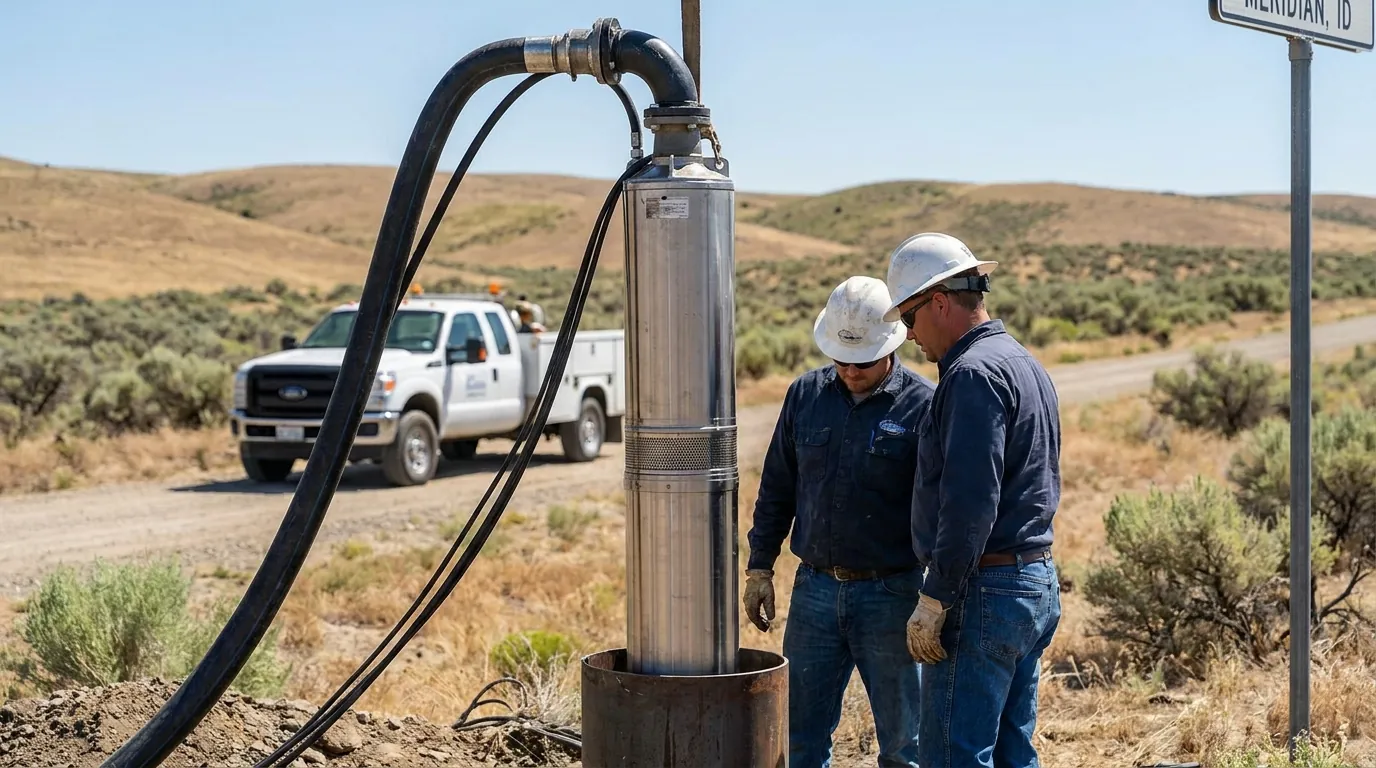
What a submersible pump does
Most modern wells in the Meridian area use a submersible pump — a sealed motor and pump set deep in the well casing, below the water, pushing water up to the surface. Because it sits out of sight and often hundreds of feet down, its symptoms show up far away: at the taps, the pressure tank, and the breaker panel. Common signs of trouble are no water, pressure that fades, a breaker that trips on startup, or sand and air in the water.
Servicing a submersible pump covers testing to find the fault, repairing what can be repaired, and replacing the unit when the motor has failed. Because reaching the pump means pulling the entire drop pipe, the diagnosis matters as much as the repair — it determines whether the fix is at the surface or down the well. This work overlaps closely with well pump repair and, when the motor is gone, well pump replacement.
How submersible service works
The goal is to confirm the fault is downhole before anything is pulled, then to do the downhole work cleanly if it is.
-
Rule out the surface first
We test the pressure switch, tank, and control box, because many apparent pump failures are surface faults that don't require opening the well.
-
Read the pump's electrical values
Insulation resistance and amp draw on the pump wiring show whether the motor is drawing correctly, shorted, or open — the key to whether it can be saved.
-
Pull the assembly if needed
When the readings point downhole, we pull the drop pipe, wire, torque arrestor, and pump, inspecting the check valve and splices as they surface.
-
Repair or replace
We correct a failed check valve, splice, or torque arrestor where that's the fault, or install a matched replacement pump when the sealed motor has failed.
-
Reset and verify
We re-splice, re-set the pump at the proper depth, pressurize, set the switch, and confirm steady output and normal cycling before we close up.
How valley conditions affect downhole pumps
Submersible pumps live or die by their setting depth, and that depth has to respect the water table. Across Kuna, Nampa, and the Eagle and Robie Creek foothills, water levels vary and move with the season. In dry Idaho summers the pumping level can fall, and a pump set too shallow starts pulling air — the sputtering and pressure loss that often gets blamed on the motor. We weigh the pumping level, not just the resting level, when setting or re-setting a pump.
Mineral-rich water is the other steady factor. Scale forms on the pump intake, impellers, and check valve, cutting output over time and making the motor work harder on each cycle. Sand in the water is abrasive and wears a pump faster still. These conditions are why two identical pumps in different Meridian wells can have very different lifespans. Winter adds freeze risk to the above-ground side of the system, which we check during service. When output has been slipping gradually rather than failing outright, a low water pressure diagnosis or a full well inspection often tells the fuller story.
Trouble with a downhole pump?
Describe what the system is doing — no water, fading pressure, tripping breaker, or sand and air at the taps — and we'll explain the likely downhole cause.
Serving Meridian, Kuna, Eagle, Nampa, Boise City, Caldwell, and Robie Creek.
Frequently asked questions
How do I know if my submersible pump is bad?
Signs include no water, pressure that won't recover, a breaker that trips on startup, and sand or air in the water. Because the pump is downhole, electrical readings on the wiring are what confirm a motor fault versus a surface problem.
Can a submersible pump be repaired in place?
The pump itself can't be worked on without pulling it, since it sits at the bottom of the drop pipe. Some faults — a check valve, a splice, a torque arrestor — are repaired when the assembly is up. A failed sealed motor is replaced rather than rebuilt.
Why is there sand or air in my water?
Sand can mean the pump is set too close to the bottom or the well is drawing fines; air often means the pump is pulling air because the water table has dropped or a check valve is leaking back. Both are worth diagnosing before they wear the pump further.
How deep is my submersible pump?
It varies widely by well — some sit under a hundred feet, others past two hundred, depending on the water table at the time the well was drilled. The setting depth is one of the first things we confirm when servicing the pump.